You made the ad, picked the audience, set the budget, and read the copy three times before you hit Publish. Now you assume Meta takes your ad, looks at the targeting, and says: "Perfect, we'll show it to the people you picked." Not quite.
Meta Ads (the advertising system running across Facebook, Instagram, Messenger, and the Audience Network) doesn't work like a catalogue where you pick a shelf and get exactly that shelf. Behind the Publish button, one of the most sophisticated recommendation systems in the world kicks into motion. Your ad enters a competition with millions of other ads, and Meta tries to answer, in a few milliseconds, a question that only sounds simple: who, right now, actually deserves to see this specific ad?
The first thing to forget about targeting
The myth is simple: "I targeted women 30–45 in Bucharest interested in X, so my ad reaches women 30–45 in Bucharest interested in X."
The reality is different. Targeting sets who is eligible, meaning which pool of people the system is allowed to choose from. It doesn't decide, on its own, who actually gets the impression.
Targeting answers "who can we show this to?" The recommendation system tries to answer a much harder question: "who deserves to see it?"
That distinction is what most ads miss, and it's where most of the "I targeted correctly, but it's still not working" frustration comes from.
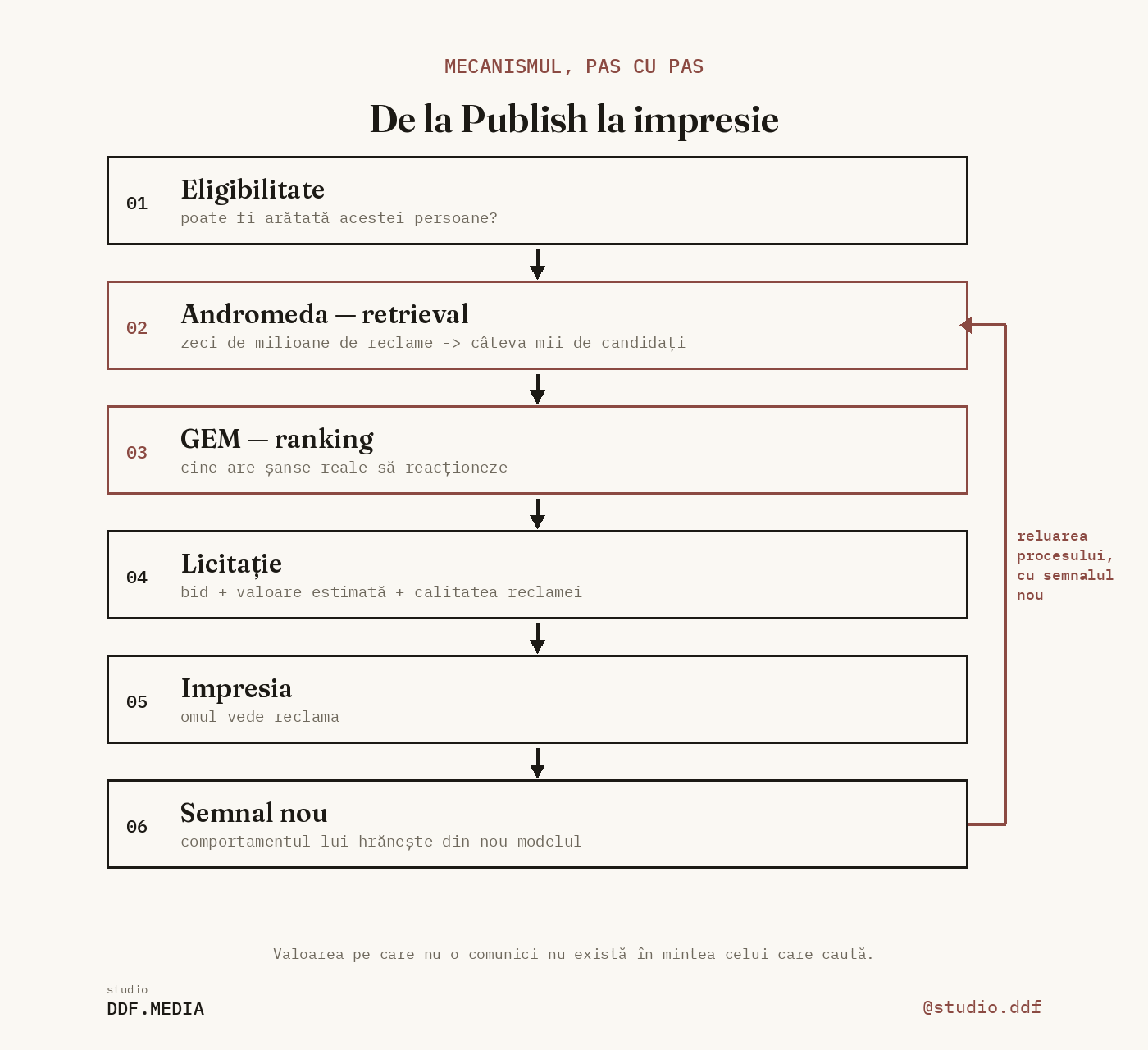
The mechanism, step by step, from Publish to impression.
Step 1. Too many ads to consider all of them
Picture a library with 50 million books. Someone asks you: find me the 2,000 most interesting ones for this person. You can't read all the books. You need a first cut.
That's what Andromeda does, Meta's retrieval system: it starts from tens of millions of candidate ads and narrows them down to a few thousand, relevant for the next stage. It runs on dedicated infrastructure, built specifically for this scale of computation, and Meta has reported improvements in recall and ad quality since introducing it.
Important, because this is where most simplified explanations get it wrong: Andromeda doesn't pick the "winning ad." It makes the first big cut, from everything that exists to what's worth considering for the person in front of the screen.
Step 2. Meta tries to understand the person, not just categorize them
Here's where it gets interesting. Meta doesn't just look at who someone is. It looks at what they do.
If you say you like sneakers, that's one data point. If in the past few weeks you've viewed 18 pairs, clicked on 7, visited 3 sites, and bought one pair, the system already has a much richer story about you, built from behavior, not from a stated preference.
In practice, Meta learns your intent from behavior, not just from what you state.
Step 3. This is where GEM comes in
If Andromeda is the person at the library entrance, GEM (Generative Ads Recommendation Model) is one of the "brains" trying to work out which ad actually makes sense for you. Meta describes it as the foundation model behind its ad recommendation system on Facebook and Instagram, trained on user behavior and on representations of the ads themselves, including the creative.
The question it's trying to answer isn't "is this a beautiful ad?" and it isn't "the person ignored it, so it must be bad." The real question is: what's likely to happen if I show this exact ad to this exact person, right now?
Step 4. Your ad enters the auction
Three ingredients show up here: how much you're willing to pay, how likely the system estimates the person is to respond, and how good the experience the ad delivers actually is.
Brand A says "I'm willing to pay." Brand B says the same. But the system estimates the person is more likely to respond to B, and B also delivers a better experience. In that case, B can win, even with a smaller budget.
It's not simply the ad with the biggest budget that wins, otherwise all you'd need would be a credit card, not a strategy.
Step 5. And then your ad learns from what happens
The person sees the ad. They react, one way or another. Meta learns from that reaction, and the predictions get refined for the next rounds.
A behavior isn't a verdict. It's a signal. And millions of signals like this build the models that try to predict what will work next time.
So what's actually left for you to do?
This is the part most advertisers miss. If Meta has more and more power to find the right people, the quality of what you feed the system becomes more important, not less.
It's no longer enough to say "we're targeting women 30–45." You need to know what you're promising, to whom, why now, what emotion you're activating, what problem you're solving, and what the person needs to understand in the first two seconds.
This is where setting up a campaign turns into building a communication strategy.
Why a "good" ad can still fail
A few plausible scenarios, not fixed rules Meta confirms as algorithmic policy:
"I targeted correctly, but it's still not working." Maybe the audience isn't the problem.
"My CTR is good, but I have no sales." Maybe the ad promises something the landing page doesn't deliver.
"The ad looks great, but it's underperforming." Maybe it's built for the marketer's eye, not the customer's mind.
"I changed the budget and it's still not working." Maybe you're trying to scale a message that isn't producing the right signal yet.
"I turned on Advantage+ and it's spending money badly." Maybe the system is getting a weak input or a poorly defined objective, not that it "doesn't know what it's doing."
What this means for anyone making ads right now
The creative isn't just what the person sees anymore, it's also what the system learns about your ad.
A good ad has to work for two "brains" at once: the person's brain, and the system trying to anticipate their behavior. The goal is to give it a signal clear enough that it can find, on its own, the people for whom your message genuinely makes sense, not to trick it.
The algorithm can find the people, test, and learn. But it doesn't invent the reason someone should care about your brand. That's where strategy and creative work begin, and for now, that part stays entirely yours.
Have a brief or just an idea? Let's start there.
Tell me about your project →